There’s a particular issue that a lot of home owners and designers face at some point: walls that appear like it’s finished, but feels empty. The color of the paint has been chosen with care, furniture is placed in the right place and lighting has been considered but something isn’t there. The solution most of the time is the dimensions. Thick textured wall art solves this issue directly and immediately with a visual impact. In 2026, it’s been one of the most sought-after solutions from interior designers from the commercial, residential and hospitality industries to add the illusion of depth, tactility and character to plain surfaces.
What Makes Textured Art Structurally Different
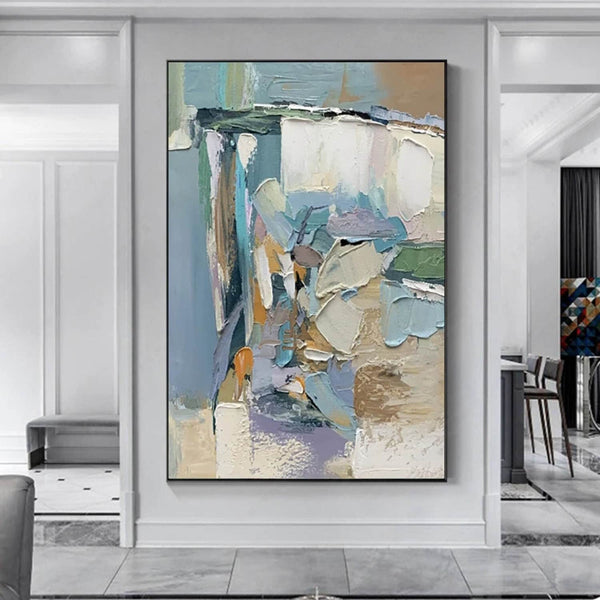
Wall art that is standard such as an image on canvas, a frame-mounted photograph or flat art can be positioned on a wall in a straight line and is able to interact with the surrounding principally through composition and colour. Textured art works in a different physical premise. It is projected outwards from the wall’s surface and produces a three-dimensional effect that interacts with the ambient and directionally oriented light with a way that art flat can’t duplicate.
The process of creating high-end Thick textured wall art generally involves several layers of material that are layered over a hard substrate. Makers and artists use a mix of gesso, modeling paste as well as acrylic gel mediums natural fibres, sand and heavy-body acrylic paints to create relief on the surface that ranges from a few millimetres up to several centimetres deep. The process of layering is sequential and each layer has to be dried before the next one can be applied, which means one piece of art could take anywhere between 20 and 60 hours of manufacturing time according to its size and complexity.
From a science standpoint the texture itself has an important structural function. Multiple layers of cured modelling compound and acrylic medium produce a surface that is much more resilient to cracks due to humidity than a single, thick layer is. This is why professional grade created art that is properly textured is generally more durable as it appears.
The Role of Light in Activating Texture
One of the lesser-known advantages of richly textured wall art is the way it interacts with light. The surface that is textured does not just reflect light, it is able to break it. The areas with high points receive the direct sunlight and look more bright, while areas that are recessed fall into shadow. This produces a dynamic perception of the space based on timing of the day as well as the angle of light, as well as the location of artificial lighting within the space.
Interior lighting designers usually call this the “raking light effect.” If a lighting source is placed at a low angle to a surface with a texture this dramatically emphasizes its relief. This makes simple textures appear striking and artistic. This is the reason why Thick textured wall art works best in rooms that feature track lighting, adjustable spotlights or even strategically placed floor lamps. The same artwork can appear serene and delicate in the presence of diffused overhead lighting, but dramatic and striking under the direction of a spot providing a range of options that flat art can’t match.
The research published in The Journal of Environmental Psychology in 2024 revealed the rooms that had textured wallssuch as textured wall art were consistently judged as more relaxed, and more personalized by participants of the study as in comparison to rooms with smooth flat surfaces. This research confirms what designers have observed in their research for decades: texture is a source of psychological relaxation in interior spaces.
Why This Trend Has Accelerated in 2025 and 2026
The emergence of the interest in 3D and texture wall art is connected to a variety of converging causes. First, the widespread acceptance of minimalist design in the past decade has led to areas that are visually clear but are often a sensory flat. Textured art can reintroduce visually appealing tactile elements without altering the minimalist aesthetic. In addition, the expansion of rental services for short-term rentals and boutique hotels has fueled an increased demand for spaces that are well-curated and memorable with statement pieces that are textured acting as one of the most cost-effective methods for creating that feeling.
The Google Trends data from the beginning of 2026 show that the interest of users in three-dimensional wall art as well as sculptured canvas art has increased by around 95 percent over three years. The decorative art market segment that includes hand-crafted sculptures and textured artifacts is expected to expand by a compound annual amount of 8.2 percent until 2029, according to a market analysis released in the journal Allied Market Research.
The way consumers shop has changed. A survey by Houzz discovered the 44 per cent of home owners who have renovated or remodeled in the past 12 months bought at the very least one unique or hand-crafted artwork that was three-dimensional or textured, with these pieces ranked in the three most popular categories for purchases. This is indicative of a shift away from the mass-produced, generic décor towards pieces that have tangible art and craft value.
Choosing the Right Piece for Your Space
Scale is the primary consideration when choosing Thick textured wall art. An artwork that does not fit on the wall will appear more decorative than purposeful. In general one large-format piece must be at least 2/3 of the space it covers. For walls larger than 2.5 meters, a triptych or diptych collection of different panels may make a harmonious composition and still maintain the visual weight the room requires.
Color selection for textures is a lot more difficult in comparison to flat artworks because the 3D surface enhances the contrast of colours. Neutral tones, such as creams, whites, warm greys, as well as raw umber are the most flexible selections because they permit the texture to be the principal visual element, instead of being a rival to colour saturation.
The mounting requirements differ from the standard art. Because of the weight of the layers that are built up high-quality richly textured artwork on large canvasses should be hung using wall anchors that are rated to the weight of the artwork which could range between 3 and 12 kilograms depending on the size of the canvas and the density of the material.
Texture as a Design Decision, Not a Detail
The trend towards three-dimensional and tactile design in contemporary interiors is not just a flims style decision. It is an appreciation of how surfaces influence the sensory appeal of an area. A wall that is flat, properly proportioned or painted, gives the eyes nothing to discover. Thick textured wall art alters this fundamentallyit creates shadow relief, a sense of relief, and a material appearance that makes rooms appear more thoughtful, layered and complete.
In a design environment where differentiation is a key factor while personal expression gets a priority over matching sets the use of texture is among the most precise and efficient tools at hand.