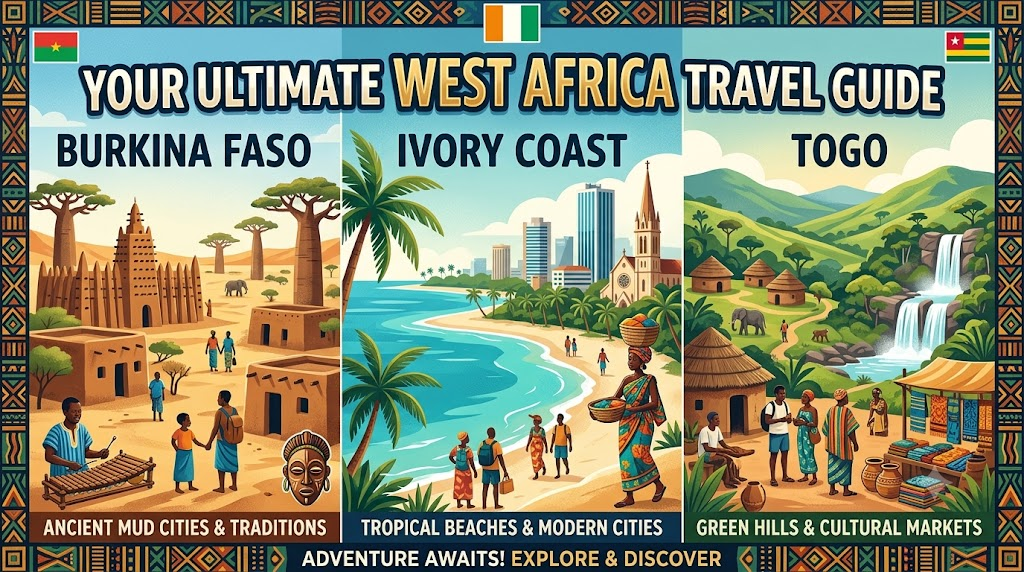
West Africa is one of the most rewarding and culturally rich regions on the planet. From golden tropical beaches and misty mountain forests to ancient clay architecture and energetic city streets, it offers an unforgettable adventure.
If you are planning a trip to Burkina Faso, Ivory Coast (Côte d’Ivoire), and Togo, this comprehensive guide will help you sort out your itinerary, understand local customs, and secure your travel documentation with ease.
Why should you put West Africa on your travel bucket list?
Many travelers overlook West Africa in favor of more mainstream tourist hubs, but those who make the trip find a region filled with raw beauty, deep history, and unparalleled hospitality.
These three countries—Burkina Faso, Ivory Coast, and Togo—pack an incredible variety of experiences into a relatively compact geographic area. You can spend one day exploring the historic French colonial architecture of Grand-Bassam in Ivory Coast, the next trekking through the lush, cocoa-producing hillsides of Kpalimé in Togo, and another appreciating the geometric clay mosques of Burkina Faso.
If you want a travel experience that feels authentic, vibrant, and completely off the beaten path, West Africa is the perfect destination.
What do you need to know before traveling to Burkina Faso?
Burkina Faso is a landlocked nation famous for its incredible arts scene, deep-rooted musical heritage, and warm communities. The local name literally translates to “The Land of Honest People,” and travelers quickly discover that the warmth of the Burkinabè people is very real.
Historically, Burkina Faso has been a major hub for African cinema and craftwork. While safety conditions mean travelers must plan carefully and stick to secure zones, the cultural centers of Ouagadougou (the capital) and Bobo-Dioulasso remain places of immense artistic pride.
Bobo-Dioulasso, in particular, is famous for its stunning Grand Mosque, built in the late 19th century out of mud-brick and timber spikes, representing a classic example of Sudano-Sahelian architecture.
How do I get a tourist visa for Burkina Faso?
Unlike some parts of the world where you can simply turn up at the border, Burkina Faso requires almost all international travelers to hold a valid visa before arrival. Thankfully, the country has adopted modern digital systems to make this much easier for tourists.
Instead of visiting an embassy in person, wasting hours in transit, and mailing your physical passport, you can submit your application digitally.
To secure your entry hassle-free, you can easily apply for your Burkina Faso eVisa online. Simply fill out the digital application, upload your passport scans, and wait for your electronic approval document.
What are the must-visit attractions in Ivory Coast?
Ivory Coast is a country of fascinating contrasts. It seamlessly blends soaring modern skyscrapers, quiet coastal villages, and vast national parks.
Here are the top places you should add to your itinerary:
Abidjan: Often called the “Manhattan of West Africa,” this is a massive, pulsing metropolis. It features incredible dining, nightlife, and the stunning St. Paul’s Cathedral.
Yamoussoukro: The official political capital is home to the Basilica of Our Lady of Peace, which is officially recognized as the largest church building in the entire world.
Grand-Bassam: A UNESCO World Heritage site just outside Abidjan, historic Grand-Bassam is known for its decaying French colonial architecture and long, sandy beaches lined with open-air restaurants.
Man and the Western Highlands: If you love nature, the green, misty hills around the town of Man offer beautiful hikes, waterfalls, and unique vine bridges.
How do I apply for an Ivory Coast tourist visa online?
Ivory Coast requires most non-ECOWAS (Economic Community of West African States) citizens to get a pre-enrollment tourist visa before catching their flight.
The Ivorian government operates a highly structured eVisa system. The process involves submitting your application, paying the fee online, and obtaining a pre-approval barcoded letter. Upon arrival at Felix Houphouet-Boigny International Airport in Abidjan, you present this letter at the dedicated biometric visa desk, where they will print the physical visa sticker directly into your passport.
To start this process today, make sure to use the official Ivory Coast tourist visa .
Why is Togo often called “West Africa in miniature”?
Togo is a narrow strip of land sandwiched between Ghana and Benin, but do not let its small size fool you. It contains almost every landscape and cultural feature you can find across the wider West African region.
In the south, Lomé, the breezy coastal capital, sits right on the Atlantic Ocean, offering wide sandy beaches, excellent seafood, and bustling local markets. Just a short drive north brings you to the cooler, forested hills of Kpalimé, the coffee and cocoa capital of Togo, which is ideal for hiking, spotting butterflies, and buying handmade woodcarvings.
Further north, you will find the dry savannahs and the Tamberma Valley (Koutammakou), famous for its unique double-story clay fortress houses called tatas, which are designated as a UNESCO World Heritage site.
What are the entry requirements and visa rules for Togo?
If you want to enter Togo, you must apply for an electronic visa prior to departure. The Togolese government transitioned fully to an eVisa system, which means visas are no longer issued directly at land borders or airport counters without pre-registration.
Travelers are required to submit their personal details, flight information, and proof of accommodation online at least five business days before their trip.
To avoid travel delays and secure your entry smoothly, you can complete your Togo tourist eVisa application before booking your flights.
Is it safe to travel through Burkina Faso, Ivory Coast, and Togo?
Safety is a top priority when traveling through West Africa. The safety situation varies considerably across these three nations:
Ivory Coast & Togo: Most tourist-heavy areas in southern Ivory Coast (like Abidjan and Grand-Bassam) and southern Togo (like Lomé and Kpalimé) are generally safe for international travelers, provided you use common sense. Avoid walking alone at night, keep your valuables out of sight, and use registered transport.
Burkina Faso: Due to ongoing security concerns, extreme caution is advised. While urban centers like Ouagadougou and Bobo-Dioulasso are heavily secured, overland travel between cities can be dangerous. It is best to fly between major cities rather than drive.
Border Regions: Always avoid the northern border zones of Ivory Coast and Togo where they meet Burkina Faso, as regional security issues can spill over.
When is the best time of year to visit West Africa?
The ideal window to explore West Africa is during the dry season, which runs from November to February.
During these months, temperatures are slightly cooler, humidity levels drop, and roads are easily passable. This is also the period of the Harmattan—a dry, dusty wind that blows south from the Sahara desert, which can create a hazy sky but keeps the scorching tropical heat at bay.
The rainy season (typically from May to October) brings heavy downpours that can wash out dirt roads, particularly in rural areas, making travel slower and more challenging. However, if you travel during this time, the landscapes are incredibly lush, green, and beautiful.
Do I need a Yellow Fever vaccination certificate for these countries?
Yes. A Yellow Fever vaccination certificate is a mandatory entry requirement for Burkina Faso, Ivory Coast, and Togo.
When you land at the airport or arrive at a land border, immigration and health authorities will ask to see your physical “Yellow Card” (the International Certificate of Vaccination or Prophylaxis). If you do not have a valid, stamped certificate showing you received the vaccine at least 10 days before your arrival, you may be denied entry or forced to pay for an on-the-spot vaccination, which is highly discouraged.
How do I manage money, cash, and cards in West Africa?
All three of these nations use the exact same currency: the West African CFA Franc (XOF).
Because they share a currency, you can easily carry your physical cash across the borders without needing to constantly exchange your money. Here are a few essential tips for managing your money:
Cash is King: Credit cards are rarely accepted outside of luxury hotels, upscale restaurants, and major supermarkets in Abidjan or Lomé.
ATMs: You can easily find ATMs in larger cities (look for banks like Ecobank, SG, or Orabank), but they can occasionally run out of cash on weekends.
Carry Small Change: It is notoriously difficult to get change for large bills (like 10,000 CFA notes) in local markets or from taxi drivers. Keep a steady supply of 1,000 and 2,000 CFA notes handy.
Why should you choose our visa services for your West African journey?
Planning a trip across multiple West African borders involves navigating different immigration rules, file formats, and payment portals. We are here to make your pre-travel planning stress-free, straightforward, and secure.
Here is why travelers trust us to handle their travel documentation:
Reliable Travel Visa Services: Our global approach has assisted numerous travelers in successfully obtaining their visas with absolute precision.
Round-the-Clock Assistance: Reach out to us 24/7. Our dedicated team of customer experts is always ready to assist and will respond to your inquiries within 72 hours.
Experienced Visa Consultants: Receive expert, hands-on guidance to ensure your application meets every country’s specific guidelines, minimizing any chance of rejection.
Efficient Visa Application Process: Skip the confusing government layouts. Apply for your tourist visas in minutes using our highly simplified, user-friendly digital forms.